
We analyzed this claim: is it true that
Binance Japan kept withdrawals of 16 cryptocurrencies blocked nearly two weeks after the global Binance theft even though it said local customer assets were untouched?
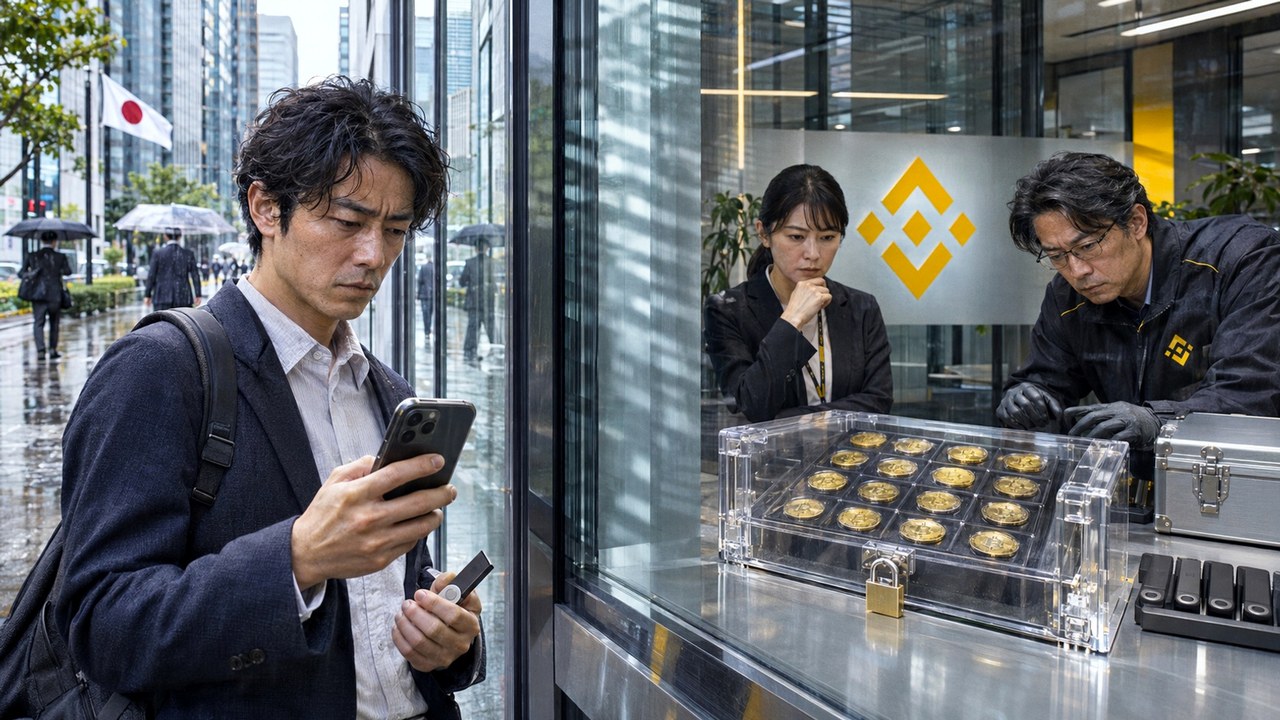
Binance Japan's November 12 notice lists 16 blocked cryptocurrencies while stating local funds were unharmed, leaving the restriction verified, the custody claim unverified by outside auditors and individual asset delays unexplained.
 ClaraAuthorComing December 1
 RafaVisual artistComing December 1
 JolinaMarketingComing December 1
Binance Japan Keeps 16 Crypto Withdrawals Blocked Despite Safe-Asset Claim
Nearly two weeks after a $6.3 billion global parent hack, Japanese users still cannot move 16 digital currencies out of the exchange.
In a nutshell
After hackers stole about $6.3 billion from parent company Binance Global on October 29, 2026, Binance Japan froze all cryptocurrency withdrawals even though it said local customer coins were safe in separate offline wallets. Over the next two weeks, the Japanese subsidiary gradually reopened full withdrawals for 44 cryptocurrencies and partial access for five, but 16 remained locked as of November 12 without individual explanations. Unexplained contradictions in its daily status lists—including declaring the coin NEAR fully restored on November 11 before listing it as blocked on November 12—and the lack of an independent wallet audit leave open why certain customer assets remain inaccessible.
Highlights
- Hackers stole roughly $6.3 billion from Binance Global's online hot wallets on October 29, 2026, prompting Binance Japan to freeze all crypto withdrawals the next day.
- Binance Japan missed its initial 48-hour recovery estimate, expanding full withdrawals from eight cryptocurrencies on November 2 to 44 on November 12.
- As of November 12, 44 cryptocurrencies were fully available for withdrawal, five were partially available and 16 remained completely blocked.
- Binance Japan listed the cryptocurrency NEAR as fully restored on November 11, then placed it back among the 16 unavailable coins on November 12 without explanation.
- No independent audit has verified Binance Japan's claim that Japanese customer holdings were unaffected, and the exchange has not explained why each of the 16 coins stays locked.
Binance Japan Cryptocurrencies Fully Available for Withdrawal
cryptocurrenciesThe findingFull withdrawal access rose steadily across every reported update, climbing from eight cryptocurrencies on November 2 to 44 on November 12.
- This chart tracks how many of Binance Japan's 65 cryptocurrencies regained full withdrawal access across six official updates from November 2 to November 12.
- Fully available — Cryptocurrencies that customers can withdraw across every blockchain network supported by Binance Japan.
- Steady expansion shows the exchange is restoring service in batches, though 21 cryptocurrencies remained partially or completely blocked after two weeks.
Binance Japan Withdrawal Status Breakdown Across Late Recovery Updates
| Status Category | Nov 9 | Nov 11 | Nov 12 |
|---|---|---|---|
| Fully available | 29 | 36 | 44 |
| Partially available | 7 | 5 | 5 |
| Unavailable | 29 | 24 | 16 |
- This table compares the exact count of cryptocurrencies in each withdrawal category across Binance Japan's November 9, November 11 and November 12 notices.
- Partially available — Coins that can be withdrawn through at least one supported blockchain network while another network remains blocked.
- Tracking all three categories shows that while blocked coins dropped from 29 to 16, partial restrictions persisted and individual coins like NEAR moved backward without explanation.
From the Editor’s Diary
Keeping customer funds in separate offline storage protects them from an online wallet theft, but customers still lose access when shared withdrawal systems shut down for security checks. Until an exchange explains specific technical blocks and reconciles conflicting status notices, safe-custody claims alone do not tell users when they can actually move their money.
Who's involved
Binance Japan
The locally regulated Japanese subsidiary of Binance that holds customer funds and runs trading in Japan
goal → Protect local customer holdings, restore withdrawals safely, meet Japanese custody rules and keep user trust
Binance Global
The parent international cryptocurrency exchange group whose online wallets were breached in the October 29 theft
goal → Contain the hack, replace stolen funds, rebuild wallet security and restore global exchange operations
Binance Japan customers
Individuals and businesses in Japan using Binance Japan to store, trade or transfer digital currencies
goal → Regain full access to their coins, receive clear status updates and avoid financial loss
Japan Financial Services Agency (FSA)
Japan's financial regulator overseeing registered cryptocurrency exchanges and customer protection rules
goal → Enforce customer-asset segregation and proper risk controls under Japanese law
In short
Japanese customers of Binance Japan still cannot withdraw 16 cryptocurrencies nearly two weeks after attackers stole about $6.3 billion from its global parent exchange, showing that legally separated digital funds can remain frozen when shared operational systems undergo post-breach checks.
Next, Binance Japan is likely to keep unlocking assets in small batches while facing pressure to explain why specific coins remain blocked and why its daily status lists contradicted themselves.
That outcome is likely, because the subsidiary has steadily expanded withdrawals from zero to 44 cryptocurrencies over two weeks, though full clarity depends on whether the company publishes blockchain-by-blockchain explanations and reconciles its conflicting notices.
How it unfolded
A global wallet breach freezes a separate Japanese exchange
At 20:05 UTC on October 29, unauthorized transfers began draining online hot wallets—digital storage connected to the internet for fast transactions—controlled by Binance Global. Blockchain tracking firm TRM Labs documented about $6.36 billion moved across ten blockchains, and Binance later acknowledged roughly $6.3 billion in losses.
Although the theft hit global wallets, Binance Japan suspended all cryptocurrency deposits and withdrawals at 03:22 UTC on October 30 as a precaution. This set up the central tension of the following two weeks: local funds were supposedly untouched, yet customers could no longer move them off the platform.
Japan declares customer assets safe but keeps withdrawals locked
On October 30, Binance Japan announced that it had inspected its systems and found all Japanese customer assets intact inside offline cold wallets—storage disconnected from the internet. Under Japanese law, registered exchanges must keep customer assets separate from company funds, though those rules do not provide an immediate, incident-specific audit.
The exchange restored trading, crypto deposits and Japanese-yen transfers that day, and predicted crypto withdrawals would reopen within 48 hours. That promise quickly slipped as parent company Binance Global began wider infrastructure reviews, making a quick Japanese reopening less likely.
A promised quick fix turns into a slow, network-by-network rollout
Instead of reopening all withdrawals at once, Binance Japan began restoring coins in small groups on November 1. By November 2, eight major coins including Bitcoin and Ether were fully available, while three others—Avalanche, GRAM and Arbitrum—were only partially available, meaning users could withdraw them on some blockchains but not others.
On November 3, the subsidiary expanded full access to 17 coins while parent company Binance Global disclosed an internal wallet-signing breach. The phased rollout proved recovery was moving forward, but showed that Japanese access remained tied to broader technical fixes.
Withdrawals expand further while an unrelated bank glitch interrupts yen transfers
Recovery picked up speed during the second week. By November 9, Binance Japan had fully reopened withdrawals for 29 cryptocurrencies and partially reopened seven, leaving 29 blocked across its 65 listed assets, though it did not specify which individual blockchains remained closed for partial coins.
On November 10, Japanese-yen deposits and withdrawals through partner GMO Aozora Net Bank stopped for two hours after the bank flagged suspicious external traffic. That brief outage stemmed from a separate banking connection issue rather than the crypto hack, leaving the steady crypto recovery intact.
NEAR vanishes from the restored list as 16 cryptocurrencies stay blocked
The final two notices showed both major progress and glaring contradictions. On November 11, Binance Japan listed NEAR—the token of the NEAR Protocol blockchain—twice as fully available, only to place NEAR back among 16 unavailable coins on November 12 in both Japanese and English notices without explanation. GRAM similarly bounced from partially available on November 9 to unavailable on November 11 and back to partial on November 12.
Even so, November 12 brought full access to nine more coins, lifting fully available assets to 44 alongside five partial and 16 unavailable coins. A separate November 11 compliance notice blocking transfers with MEXC-linked platforms followed U.S. money-laundering sanctions and did not explain why the 16 coins remained locked, leaving questions about reporting accuracy.
Where things stand
As of November 13, 2026, Binance Japan's November 12 notice remains its latest official update. Across 65 listed cryptocurrencies, 44 are fully open for withdrawal, five—ARB, FET, FIL, GRAM and MASK—are partially open on undisclosed networks, and 16 remain completely blocked: BCH, HBAR, DOT, ATOM, XTZ, NEO, THETA, A, GALA, QTUM, TRB, ONT, ZIL, IOTX, IOST and NEAR.
Binance Japan has not explained why each of the 16 coins remains locked. While DOT, QTUM and ZIL already had separate deposit suspensions linked to blockchain upgrades, no verified technical reason has been published for keeping any of the 16 withdrawals frozen, and NEAR's sudden reversal remains unexplained.
No independent, incident-specific audit of Binance Japan's wallets has been published. Although Japanese law requires exchanges to segregate customer assets, Binance Japan's claim that local funds were untouched remains an unverified company statement, leaving open whether every ongoing freeze is technically necessary.
Sources
- Binance Japan, response and customer-asset assurance
- Binance Japan, company press release distributed by PR TIMES
- Binance Japan, third service-resumption notice
- Binance Japan, fourth service-resumption notice
- Binance Japan, fifth service-resumption notice
- Binance Japan, sixth service-resumption notice
- Binance Japan, seventh service-resumption notice
- Binance Japan, GMO Aozora Net Bank temporary suspension
- Binance Japan, GMO Aozora Net Bank service restoration