
We analyzed this claim: is it true that
SBI Holdings and Sumitomo Mitsui Financial Group launched a Solana-based joint venture for stablecoin payments and asset tokenization?
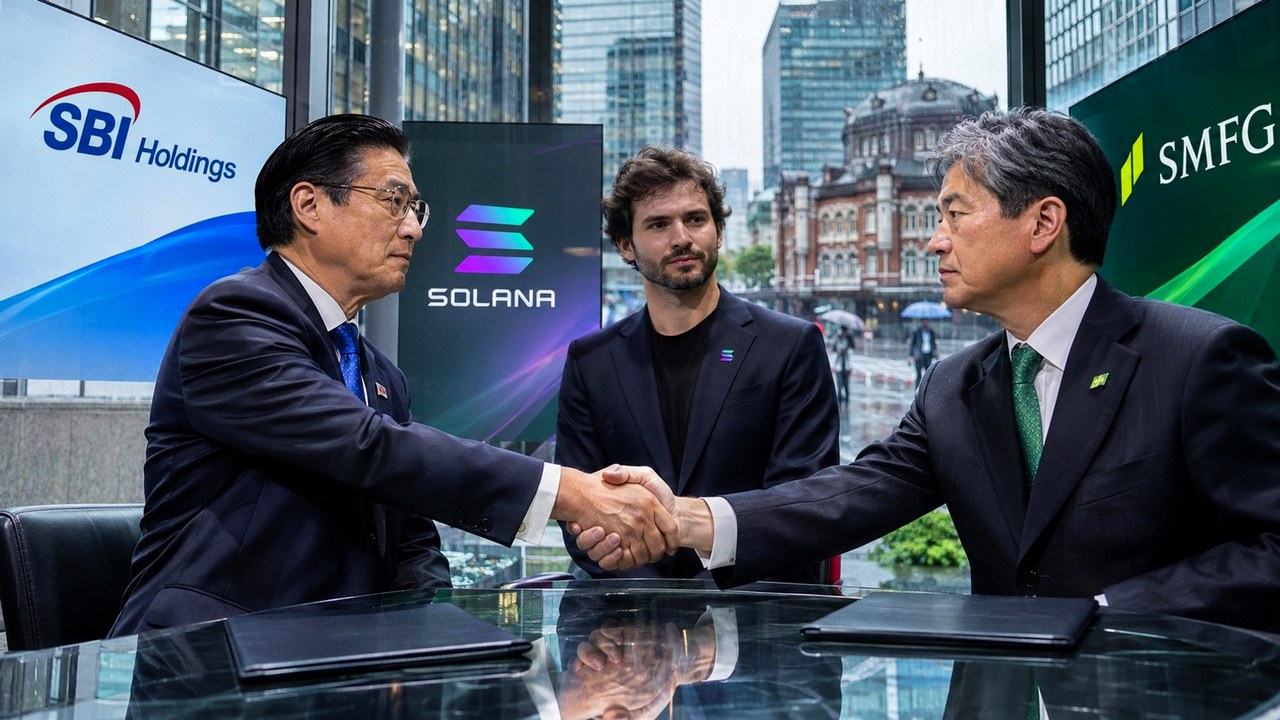
Both Japanese financial groups confirmed on November 25, 2026, that SBI Solana Global began operating, while leaving ownership stakes, specific products and rollout dates undisclosed.
SBI and SMFG launch blockchain venture without product dates
Two of Japan's largest financial groups have teamed up with the Solana Foundation to build blockchain-based payment and investment services, though they have not disclosed ownership stakes, customers or launch dates.
In a nutshell
Two major Japanese financial groups, SBI Holdings and Sumitomo Mitsui Financial Group, partnered with the Solana Foundation to rename their existing enterprise blockchain company to SBI Solana Global on November 25, 2026. The venture aims to build stablecoin payment systems and digital versions of financial and physical assets on the Solana public blockchain, starting in Japan before expanding across Asia. While a separate SBI partnership already sells a Solana-based Japanese stock fund token in Singapore and Hong Kong, SBI Solana Global has not yet disclosed its new ownership structure, funding, first customers or commercial launch dates.
Highlights
- SBI Holdings, SMFG and the Solana Foundation began operating their renamed joint venture, SBI Solana Global, on November 25, 2026.
- The venture targets four areas on the Solana public blockchain: stablecoin payments, digital financial instruments, digital records of nonfinancial assets and blockchain investment management.
- Neither SBI nor SMFG has disclosed the new ownership split, the Solana Foundation's financial contribution, R3's remaining role or any product launch dates.
- A separate SBI token called JX already runs on Solana through Singapore's DigiFT and Hong Kong's HashKey Exchange, but requires a 5,000 USDC minimum and a five-dealing-day settlement wait.
Four planned business areas of SBI Solana Global
| Business area | Planned focus |
|---|---|
| Stablecoin payments | Domestic and international payment systems using stablecoins, plus possible… |
| Digital financial assets | Issuing and distributing digital versions of bonds, investment funds and loan… |
| Nonfinancial assets and rights | Creating digital records for commodities and contractual rights, including… |
| Investment management | Building investment management services based on stablecoins and tokenized… |
- This table lists the four commercial areas that SBI Holdings, SMFG and the Solana Foundation set for SBI Solana Global on November 25, 2026.
- Stablecoin — A digital token designed to hold a steady value tied to a traditional currency such as the US dollar or Japanese yen
- Tokenization — Representing a traditional investment, physical asset or legal right as a digital token on a blockchain
- It shows the breadth of what the partners intend to connect, while highlighting that the next real milestone is turning any one of these four plans into a dated, live product.
From the Editor’s Diary
Renaming an existing corporate vehicle signals institutional commitment, not a live market. Until a blockchain venture publishes its supported currencies, regulatory terms and launch dates, its parent banks' size measures potential reach rather than actual adoption.
Who's involved
SBI Holdings
Tokyo-based financial group running banking, brokerage, insurance, investment and digital-asset businesses
goal → Build international sales channels for Japanese investments and develop blockchain financial infrastructure
Sumitomo Mitsui Financial Group (SMFG)
One of Japan's largest banking groups and parent of Sumitomo Mitsui Banking Corporation (SMBC)
goal → Connect traditional banking and securities services with emerging digital payment and investment networks
Solana Foundation
Swiss nonprofit supporting the development and use of the Solana public blockchain
goal → Encourage major financial institutions to use Solana for payments, securities settlement and digital assets
SBI Solana Global
Tokyo-based operating company formerly called SBI R3 Japan
goal → Build commercial blockchain financial services in Japan first, then expand internationally
SBI Global Asset Management
Investment management arm of SBI Holdings
goal → Open Japanese investment funds to international buyers by issuing them as digital tokens
DigiFT
Regulated digital-asset platform in Singapore focused on digital versions of traditional investments
goal → Distribute tokenized Japanese investment funds to qualified international investors
HashKey Exchange
Licensed digital-asset exchange in Hong Kong offering investment products through its HashKey Earn service
goal → Offer tokenized financial assets to eligible professional investors
R3
Financial technology company behind Corda, a private digital ledger built for banks and institutions
goal → Former joint-venture partner whose remaining ownership and contract role have not been publicly clarified
In short
Two of Japan's largest financial groups, SBI Holdings and Sumitomo Mitsui Financial Group (SMFG), have moved an existing company onto a public blockchain—a shared digital ledger open to outside networks—to build payment and investment services. The most likely next step is a first product announcement in Japan naming a supported currency, eligible customers and a launch date. It is too early to tell how quickly real business will follow, because the partners have not disclosed their funding, ownership shares, first clients or a schedule.
On November 25, 2026, at 15:00 Japan Standard Time (06:00 UTC), the two groups and the Switzerland-based Solana Foundation began operating their renamed firm, SBI Solana Global, formerly known as SBI R3 Japan. Using Solana, a public blockchain network, the venture plans to focus on four areas: domestic and international payments using stablecoins (digital tokens designed to hold a steady value, like a national currency), digital versions of financial assets such as bonds and funds, digital records of physical assets and rights, and blockchain-based investment management. The partners also note small automated payments made by artificial intelligence software as a possible future use.
A separate SBI partnership already offers a working preview. A digital token called JX gives qualified investors access to a Japanese high-dividend stock fund on Solana through Singapore's DigiFT and Hong Kong's HashKey Exchange. JX is not a product of the new venture, and its five-day settlement wait shows that using a blockchain does not automatically remove traditional banking delays.
How it unfolded
SBI and the Solana Foundation announce their partnership
SBI Holdings, the Solana Foundation and SBI R3 Japan announced a partnership on July 13, 2026, to bring the Foundation into the existing Japanese company and rename it SBI Solana Global. The company dated back to January 2019, when SBI and US financial technology firm R3 created it to sell Corda, a private ledger for banks, with SMFG buying a stake in August 2020. Repurposing an existing corporate vehicle made a formal launch more likely than starting from scratch, though at this stage it remained a plan. SBI's official release is the earliest verified record of the shift, with The Block and Japanese outlet New Economy reporting it the same day.
The plan shifts from private ledgers to a public network
The July announcement outlined a move away from private bank ledgers toward Solana's public network. The partners listed intended support for JPYSC, a yen-pegged stablecoin, along with digital investment funds, corporate debt and cross-border institutional settlement, though JPYSC was named as a goal rather than a live service. Days later, a separate SBI partnership with DigiFT launched JX, a Solana-based token tied to a Japanese high-dividend stock fund for qualified investors. That launch showed SBI could deliver a live Solana product, making the broader strategy more credible even though JX belonged to a different corporate arrangement.
SBI expands international access while traditional limits remain
In its November 2 half-year results, SBI separated three distinct partnerships: DigiFT for digital investment funds, Ondo for potential digital securities and stablecoins, and the Solana Foundation for the upcoming SBI Solana Global venture. It also confirmed that JX settled in USDC, a US dollar stablecoin, while JPYSC remained a future plan. On November 5, SBI added Hong Kong's HashKey Exchange as a second sales channel for JX, restricted to professional investors with a 5,000 USDC minimum, a 0.1% redemption fee, no external wallet transfers and a five-dealing-day settlement wait. That rollout showed international demand for tokenized Japanese funds, while making clear that blockchain products still face conventional fund rules and delays.
SBI Solana Global formally begins operations
On November 25, SBI Holdings and SMFG both confirmed that the restructuring agreements were complete and that SBI R3 Japan had begun full operations as SBI Solana Global. The launch confirmed the venture's four target areas—stablecoin payments, digital financial instruments, digital records of physical assets and rights, and blockchain investment management—along with a plan to build in Japan first before expanding across Asia. That made future product announcements more likely, but key details remained missing. Previously, the company had 500 million yen in capital and reserves and an August 2020 ownership split of 51% SBI, 35% R3 and 14% SMFG, down from 60% SBI and 40% R3 in 2019; neither group published a new ownership table, leaving the Solana Foundation's stake, R3's remaining role and any commercial launch dates unconfirmed. The Foundation's estimate that SBI and SMFG together hold over $2.3 trillion in assets and 80 million customers refers to the parent groups, not money or users committed to Solana.
Where things stand
As of November 26, 2026, at roughly 13:44 UTC, the corporate launch of SBI Solana Global is confirmed by both Japanese financial groups and the venture itself, with Solana set as its blockchain network and four business areas defined. No commercial services—such as yen stablecoin payments, tokenized Japanese stocks or tokenized bonds—have been confirmed as live, and the parent groups' combined assets and customers do not represent funds or users on Solana.
November 26 reporting from CryptoSlate, Crypto.news and New Economy added commentary on the existing JX token and its five-day redemption wait, but no new corporate or product developments occurred after November 25. Ownership percentages, R3's remaining role, the Foundation's contribution, leadership, regulatory approvals, supported stablecoins and initial customers all remain undisclosed. The next meaningful test will be a product disclosure naming service terms, eligible customers, settlement rules and a launch date.
Sources
- SBI Holdings — confirmation of SMFG's completed capital participation and revised shareholder structure
- SBI Holdings — undated predecessor corporate profile accessed on November 26; historical capital and voting-rights ownership percentages, not the revised venture's ownership
- SBI Holdings — original Japanese-language Solana Foundation strategic partnership announcement
- New Economy — Japanese-language reporting on the proposed restructuring and undisclosed ownership arrangements
- The Block — Brian Danga, reporting on the proposed SBI Solana Global venture
- DigiFT — official JX launch announcement
- SBI Global Asset Management — official JX distribution announcement for HashKey Exchange
- HashKey Exchange — official JX product eligibility, subscription, redemption and settlement conditions
- CryptoSlate — Liam Wright, analysis of JX distribution and five-dealing-day redemption settlement
- SBI Holdings — primary English-language joint announcement
- Sumitomo Mitsui Financial Group — primary English-language joint announcement
- Sumitomo Mitsui Financial Group — official disclosure register recording the 15:00 JST media release
- SBI Solana Global — official commencement-of-operations announcement
- Solana Compass — early timestamped coverage of the completed joint venture restructuring
- The Block — Danny Park, independent reporting on the launch and commercial strategy
- New Economy — Japanese-language follow-up confirming the November 25 restructuring and earlier JPYSC plans